





ACOLYTE – In the Daystar Church, this is a general term that covers not only servers, torchbearers, and lighters of candles but also crucifers, thurifers, and banner-bearers. Acolytes are mentioned as early as 252 AD in a letter of Pope Cornelius to Fabius of Antioch.
ADVENT WREATH – A circle of greenery marked by four candles representing the four Sundays of the season of Advent. An additional candle is lit as each new Sunday is celebrated in Advent. Advent wreaths are used both in churches and in homes for devotional purposes. The candles may be blue, purple, or lavender, depending on local custom.
ALB – A long white garment with narrow sleeves, the basic garment worn by ordained and lay ministers at the Eucharist and other church services. The alb (from Latin alba, meaning white) is derived from the under-tunic of the Greeks and Romans of the fourth century. It may be tied at the waist.
ALMS BASINS a/k/a Offering Plates – A plate, basket, or other container used to collect and present the alms given by the congregation. At the Cathedral, we use a large brass or silver plate to receive the smaller plates passed through the congregation.
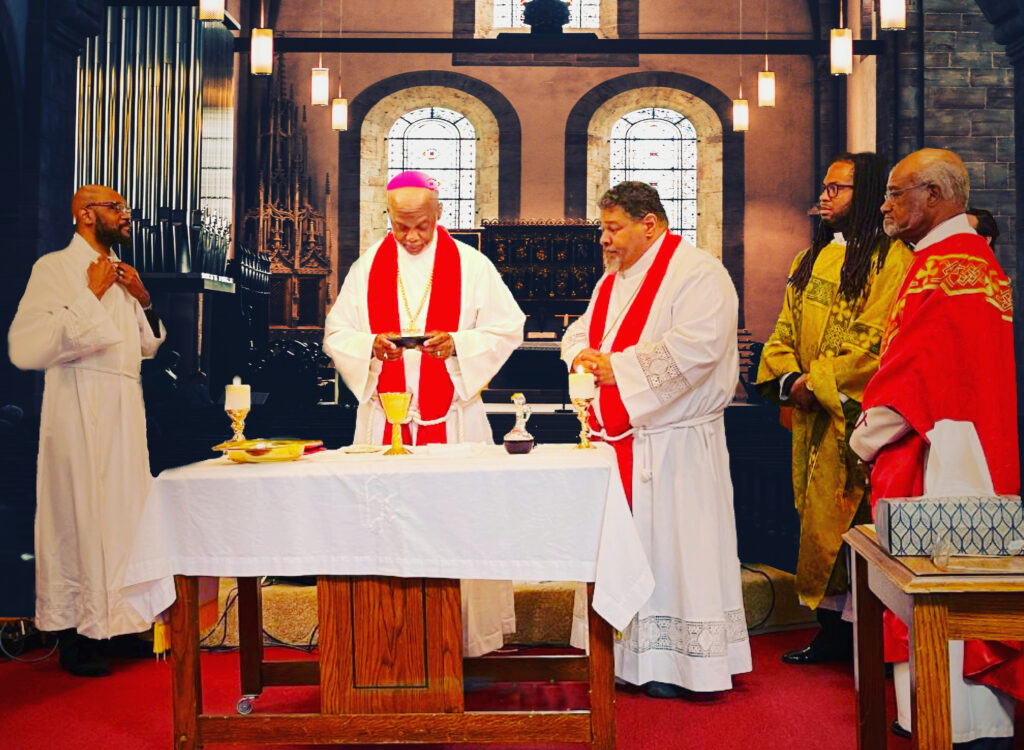
ALTAR – The structure, also known as “the Lord’s Table,” “the Holy Table,” and “the Table,” where the offerings are presented, and the elements of bread and wine are consecrated in the Eucharist.
BAPTISMAL FONT comes from the Latin fons, “spring of water,” and designates a receptacle for baptismal water. Fonts in the early church were pools and sunken basins, often in the shape of a cross, in which candidates were immersed in running water.
BISHOP – One of the three orders of ordained ministers in the church, bishops are charged with the apostolic work of leading, supervising, and uniting the church. Bishops represent Christ and his church and are called to provide Christian vision and leadership for their dioceses. Bishops stand in the apostolic succession, maintaining continuity in the present with the ministry of the Apostles.
Bishops also preside at services of Confirmation, Reception, or Reaffirmation. Bishops bless altars and fonts, and the blessing of chalices, patens, and church bells are traditionally reserved for the bishop. In the Daystar Church, the diocesan and suffragan bishops are elected by Diocesan Convention.
BOAT – The acolyte who carries the incense container for the thurifer. Also, the name of the incense container.
BOOK OF COMMON PRAYER (BCP) –
BURSE – Two squares of stiff material, hinged or bound together at one end to form a case, which contains the corporal and purificators for use at the celebration of the Eucharist. The burse is covered in the liturgical color of the day and placed on top of the veil that covers the chalice.
CANDLES – Candles are often used to signify festivity and solemnity in Christian worship. The use of such lights has a long and varied tradition. The Easter Vigil service begins with the lighting of the Paschal candle, which is to burn at all services from Easter Day through Pentecost.
CATHEDRAL –
CELEBRANT – The bishop or priest who presides at the Eucharist, and at baptism, and at other sacramental and liturgical occasions such as the Celebration and Blessing of a Marriage, Ministration to the Sick, and Thanksgiving for the Birth or Adoption of a Child. The celebrant leads the community’s celebration of these liturgies and rites.
CHALICE – The cup for the wine that is consecrated and administered at the Eucharist. The chalice normally has a footed base. Chalices are typically made of silver or other precious or semi-precious metals and may be decorated by jewels or engraved designs.
CHALICE VEIL – A square of material that covers the chalice and paten until they are needed to prepare the altar at the Eucharist. It typically matches the Eucharistic vestments and the liturgical color of the day.
CIBORIUM – a container used to hold the bread/wafers to be consecrated in the Eucharist
CINCTURE – A rope-type belt used to bind the waist of the alb.
COMMUNION RAIL – The railing on either side of the steps to the chancel where people stand or kneel to receive communion.
CORPORAL – A square white cloth placed on top of the fair linen covering the altar during communion.
CREDENCE TABLE – a place where the elements (bread and wine) are placed before they are consecrated during the Eucharist.
CRUCIFER – The acolyte who carries the processional cross. There is always one at a service. Feasts and special services have two.
DEACON – Deacons are members of one of three distinct orders of ordained ministry (with bishops and presbyters). In the Episcopal Church, a deacon exercises “a special ministry of servanthood” directly under the deacon’s bishop, serving all people, especially those in need (BCP, p. 543). Christian deacons were agents of the bishop, often with oversight of charity.
ELEMENTS – Bread and wine that are consecrated in the Eucharist. The bread recalls the work of human hands required to harvest the wheat and make the bread and the companionship of sharing. The wine recalls festivity and celebration, along with sacrifice. The congregation offers these elements of the communal meal and is blessed during the Great Thanksgiving.
EUCHARIST – The sacrament of Christ’s body and blood and the principal act of Christian worship. It is also the name given to the service where communion is offered.
The Eucharist is also called the Lord’s Supper, Holy Communion, the Divine Liturgy, the Mass, and the Great Offertory.
FLAGON – A large vessel with a handle and spout shaped like a pitcher. It is used as a container for wine or water at the Eucharist. It may be made of metal, pottery, or glass.
GIFTS, THE – see: Offering
GOSPEL BOOK – From ancient times, the gospel pericopes have been collected in a large book with an ornate cover, often illustrated and adorned with icons and jewels. A deacon or server usually carries the gospel book in the entrance procession and places it on the altar until time for the gospel proclamation. Afterward, it may be returned to the altar or placed on a side table or a stand.
INCENSE – When burned or heated, usually over charcoal, certain woods and solidified resins give off fragrant smoke. Both the materials and the smoke are called incense. There are congregations where incense is used at the Easter Vigil and other major feasts, and some parishes use it regularly on Sunday.
LAVABO – After the altar is prepared and before the Great Thanksgiving, the celebrant may wash his or her hands in a small bowl called a lavabo bowl. An acolyte or server assists by holding the bowl and pouring water over the celebrant’s hands. The celebrant’s hands are dried on a lavabo towel which hangs over the wrist of the server at the lavabo ceremony.
LINENS – The white cloths, often embroidered, used to cover the altar and within the Eucharist.
LITURGY – Liturgy is sacramental. Outward and visible realities are used to express the inward and spiritual realities of God’s presence in our lives. Liturgy is a public and social event. It engages our lives and faith, our thoughts, feelings, hopes, and needs-especially our need for salvation in Christ. The seasons, feasts, and fasts of the calendar of the church year shape liturgy.
OFFERINGS – Gifts presented at a church service or other gathering. At the offertory, prior to the Eucharistic prayer, representatives of the congregation bring the people’s offerings of bread and wine and money or other gifts to the deacon or celebrant (BCP, p. 361).
PATEN – A plate of metal or pottery used to hold the host (bread or a wafer) during the Eucharist.
PREACHER – The one who preaches the sermon. In some Protestant churches, the term is used as a title for a clergy member.
RESERVED SACRAMENT – Consecrated bread and wine may be reserved for the communion of the sick or others who, for “weighty cause,” could not be present at the celebration or for the administration of communion by a deacon to a congregation when a priest is unavailable. The sacrament may also be reserved for communion on Good Friday on Maundy Thursday. It is customary to keep the consecrated elements in a tabernacle or an aumbry or covered with a veil on a table or altar. A lamp or candle burns nearby to announce the presence of the reserved sacrament. This light is known as a sanctuary lamp if the reservation is near the altar.
SACRISTAN – A person who works in the sacristy, the room for storing and working with the various items needed for the liturgies and worship of the church. Such items may include vessels, vestments, books, bread and wine, and candles. Altar hangings and linens, sacred vessels, and liturgical books are kept until needed for use in worship.
TAPER LIGHTER – A brass and wood instrument with a wax taper string that slides up from a tube. This taper is lit and then used to light the candles within the Cathedral. It also contains a bell that is used to extinguish the candles afterward. They are kept on the left of the Sacristy door as you enter.
THURIBLE – A small metal pot on chains that burns incense during the Eucharist and other liturgies. The thurible is also known as a censer. Fragrant smoke is produced when Incense is spooned onto hot charcoals inside the thurible. The smoke escapes through holes in the thurible, especially when it is swung. The thurible is carried in procession by the THURIFER.
PURIFICATOR – A white linen cloth used to wipe the chalice
and paten during and after communion.
THURIFER – The adult who carries and swings the thurible in which incense is burned during the Eucharist and other liturgies. The thurifer, the celebrant, the deacon, or other ministers may use the thurible in the ceremonial censing of people or objects such as the gospel book or altar. The thurifer may be assisted by an acolyte, a “boat person,” who carries the incense boat or container that holds the incense that will be used during the service.
TORCH – Candles mounted on poles for use in the liturgy. Lighted torches may be carried by acolytes or servers in procession, including the gospel procession. Torches are used to enhance the solemnity and festivity of worship.
TORCHBEARER – An acolyte or server who carries a torch in procession, including the gospel procession.
VERGER – A lay minister who assists the clergy in the conduct of public worship, especially in the marshaling of processions. The history of the verger dates back to the Middle Ages when the verger was the “Protector of the Procession.” He would lead the way, making room for the procession to enter the church from the town square, and with his virge (mace) in hand would literally clear the way if necessary.
VICAR – The priest representing the bishop. The term is derived from the Latin vicarius, “substitute.” Historically, as early as the twelfth century in England, clergy known as vicars were appointed to act as substitutes or vicarious representatives of the bishop to serve congregations.
VIRGE – The virge is the staff a verger carries in procession. The name comes from the Latin virga, “rod” or “staff.” It goes back to the ceremonial mace carried before civic and ecclesiastical dignitaries. It was originally a weapon used to clear the way for processions and to control unruly choristers. One end has a cross or other Christian symbol on it. A longer variation of the virge is called the beadle, originally used to lead academic processions.